
Free entry and exit with a receipt: how to design the flow of a supermarket
A good entrance lets shoppers in without waiting and makes them leave through the tills. This guide explains how to combine free entry lanes and receipt exit lanes to organise the flow of shoppers without creating queues.
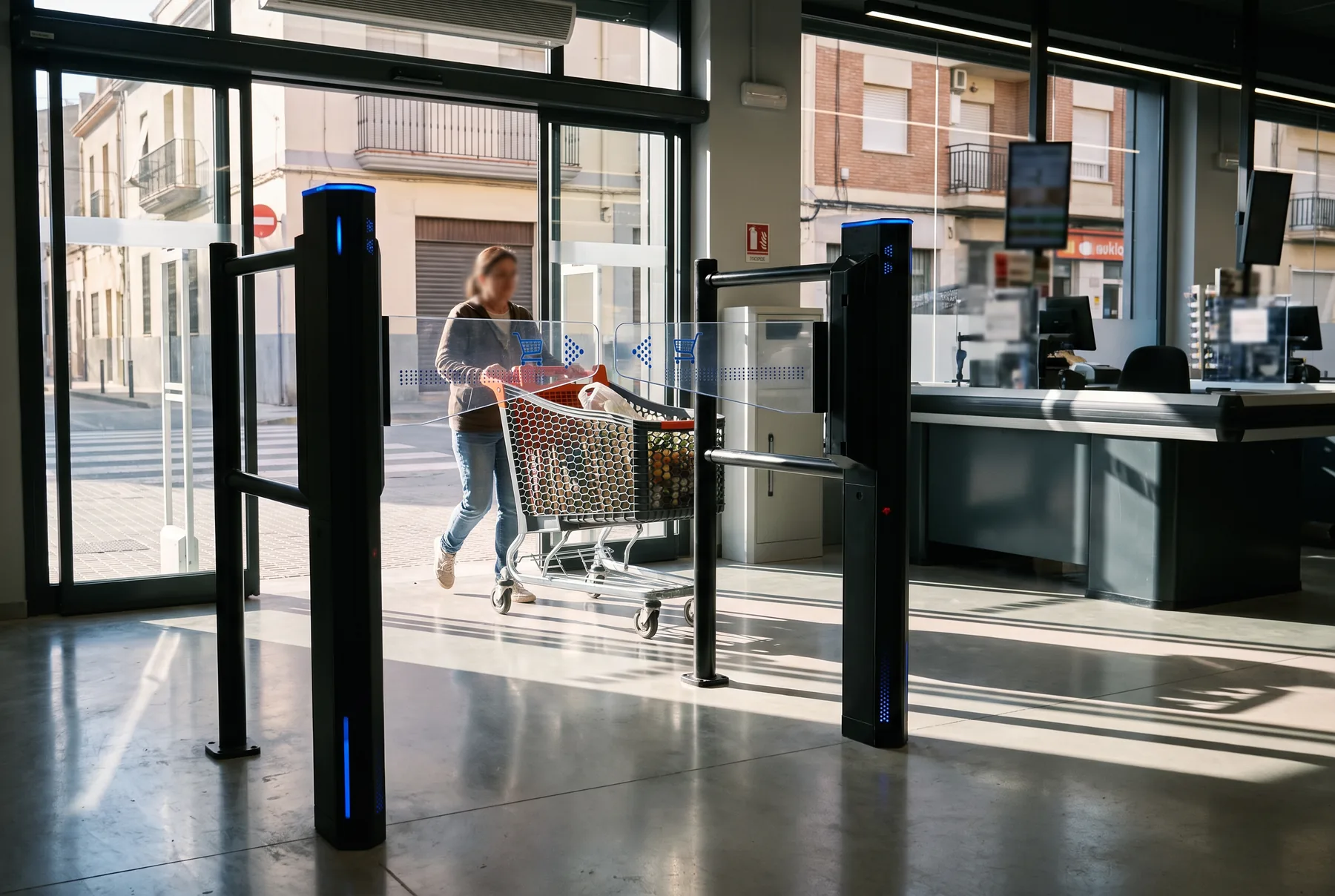
Why separate the entrance from the exit
In many supermarkets the entrance and exit share the same space, and anyone can leave through the entry area without going through the tills. Separating the two directions solves three problems at once:
- Losses. If the only way out is through the line of tills or a gate that asks for the receipt, leaving without paying is no longer so easy.
- Order. Every shopper knows where to go in and where to go out, and trolleys do not cross in the same lane.
- Data. Every opening is logged, so you know how many people come in and go out, and at what times.
The basic layout: free entry, exit with a receipt
The most common model combines two types of lane:
- Free entry lane. The gate detects the shopper by radar and opens the arm inwards. Nobody has to show anything to come in. It is advisable to configure it so that it does not open in the opposite direction, so that it cannot be used as a way out.
- Receipt exit lane. The shopper scans the barcode or QR code printed on their receipt and the gate opens outwards. The receipt is validated on the device itself and marked as used, so it cannot be used twice, even with several gates.
Traditional tills remain a natural exit: the shopper pays and leaves. The receipt exit gate mainly covers self-checkout areas and entrances where there is no line of tills acting as a filter.
How many lanes your store needs
There is no single figure. It depends on the number of shoppers at peak time, the width of the shopfront and how many tills and self-checkout points you have. To size it, review:
- Peak-time traffic. This is the moment that matters. If the entrance works well at seven o’clock on a Friday evening, it will work for the rest of the week.
- Trolley use. Large trolleys need a wide lane. The Insmartia double gate gives 1750 mm of clear width and the single gate 900 mm.
- Redundancy. With at least two exit lanes, a unit under maintenance does not leave the store without a controlled exit.
- Accessibility. At least one lane must allow a wheelchair or a pushchair to pass comfortably. The specific accessibility requirements for the premises are set by the project engineer.
Where to place each lane
- Entrance away from the tills. This way the shopper goes round the store in the intended direction and the entrance does not become an alternative exit.
- Receipt exit right after self-checkout. The shopper pays, takes the receipt and scans it a few steps away, without having to look for it again.
- Waiting space before the gate. Leave room for a shopper with a trolley to stop and scan without blocking the next person.
- Closed sides. The route should be guided with railings or furniture so that nobody goes round the gate.
Keeping the receipt from creating queues
A receipt exit only works if it is fast. These details make the difference:
- A clearly printed, visible code on the receipt, in a fixed position so the shopper finds it without thinking.
- Reader at hand height, at the top of the post, with a clear indication of where to hold the receipt.
- Local validation. If every scan has to go to a cloud server, any network slowness turns into a queue. When the Internet goes down, the store cannot be left without an exit.
- Clear signals. The illuminated arm shows whether you can go through. A vinyl showing the direction of passage and an audible tone on validation help first-time visitors.
- A plan for exceptions. Shoppers without a receipt, damaged receipts or returns: decide who opens the gate in those cases and how, so that the lane is not blocked.
Safety and evacuation
Exit control must never prevent evacuation. The gate must open on power failure and, ideally, on the fire alarm signal. We explain this in detail in our guide to evacuation rules for swing gates in Spain (CTE DB-SI). Anti-trap protection and obstacle detection are essential at an entrance used by children and trolleys.
Checklist
- Peak-time traffic estimated and number of entry and exit lanes decided.
- At least one wide lane for trolleys and accessibility.
- Entrance separated from the till area and receipt exit next to self-checkout.
- Format and position of the code on the receipt confirmed with your till system.
- Validation tested without an Internet connection.
- Evacuation route reviewed with the responsible engineer.
- Procedure for shoppers without a receipt agreed with staff.
Rethinking your supermarket entrance? See how our swing gates for supermarkets work, or configure your access.
This guide is for information only. The configuration of each store is approved by the engineer responsible for the project.